Reviewed Content Confirmed by Clinical Team

This content is created by Misyondent Oral and Dental Health Clinic's team of expert dentists. reviewed by the clinical team and validated. It is based on current clinical literature and applied dental practice.


Misyondent Specialist Dentist Team Aesthetics - Surgery - Implants - Orthodontics
Table of Contents

    You don't want to ignore your broken front tooth or the dark filling that has been bothering you for years, but going into an unfamiliar process can also be anxiety-inducing. Many of our patients in and around Bahçelievler ask the same question when coming to the clinic for zirconium dental crowns: "How is this procedure really done, what happens to my tooth, how long does it take?" Since zirconium dental veneers are one of the most reliable aesthetic restoration methods of modern dentistry, the process is much more controlled and predictable than it first sounds. In this guide, we explain the steps from the initial examination to the final bonding in a calm and understandable way, explaining when and what decisions are made, how pain management is achieved and how long the treatment actually takes.

    What is Zirconium Dental Veneers?

    A zirconium dental crown is a metal-free, highly durable full ceramic crown based on zirconium dioxide (ZrO₂). It works like a sheath that fits completely over the damaged or aesthetically renewed tooth; it restores the shape, color and chewing function of the tooth. It is also referred to as "zirconia crown" in the medical literature, and thanks to its biocompatible structure, it blends seamlessly with the gums.

    Unlike traditional metal-backed porcelain veneers, the substructure in zirconium is also ceramic, which eliminates the gray-blue line that can form at the gum line over time. Since its light transmittance (translucency) is close to natural tooth enamel, it offers a natural aesthetic, especially on the front teeth visible in the smile. Recent clinical studies report a 5-year survival rate of monolithic zirconia crowns of around , one of the highest success rates in modern restorative dentistry.

    Who is Zirconium Veneer Suitable for?

    Zirconium crowns may not be suitable for every patient. The treatment decision is made after an examination that evaluates the current condition of the tooth, gum health, the person's bite strength and aesthetic expectations together. In general, zirconium crowns are preferred in the following cases:

    • Restoration of teeth weakened by large fillings or root canal treatment
    • Teeth with fractures, cracks or excessive loss of material
    • In advanced color changes that cannot be removed by bleaching
    • In cases of mild crowding or diastema (interdental space) not suitable for orthodontic treatment
    • Patients allergic to metal alloys
    • As crowns in implant prostheses

    On the other hand, veneers are not directly applied in the presence of uncontrolled gum disease, untreated caries, excessive clenching and grinding (bruxism). In these cases, the underlying problem should be treated first; only then zirconium veneers can be planned. In patients under 18 years of age, zirconium veneers are generally not recommended in the medical literature as jaw development is still ongoing.

    🩺 Clinical Note In a significant portion of the patients for whom we decide on zirconium veneers in our polyclinic, we can detect underlying cracks or hidden caries during the examination, even if the initial complaint is aesthetic. For this reason, we recommend digital x-rays and detailed examination even for patients who say "I just want white and straight teeth". The lifespan of the veneer is directly linked to the health of the tooth underneath.

    How Are Zirconium Dental Veneers Made? Step-by-Step Treatment Process

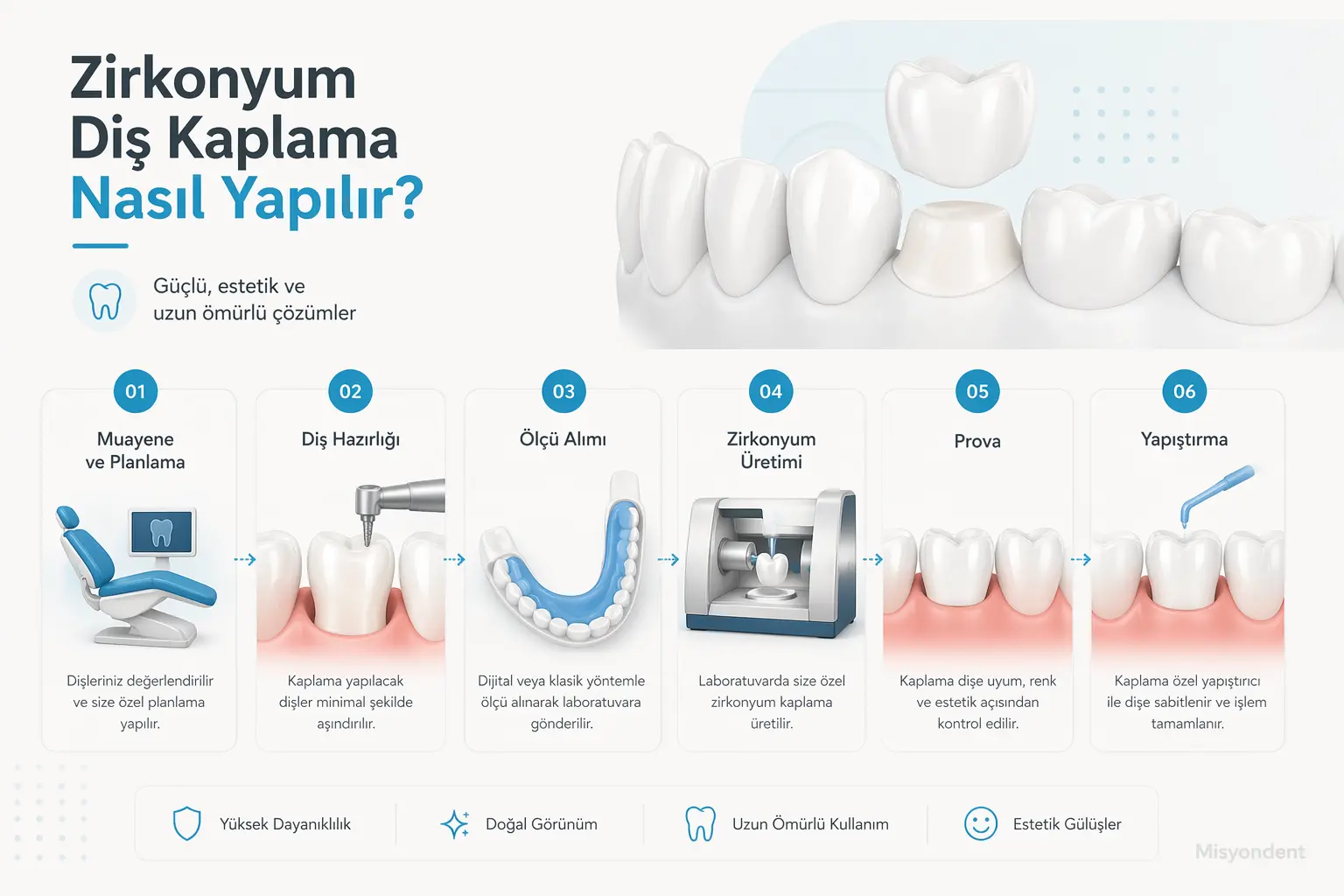
    Zirconium crown treatment is typically completed in two main clinical sessions, with a laboratory production period in between. In clinics equipped with modern CAD/CAM technology, this time can be even shorter in some cases. Let's go through the steps in order.

    1. Examination, Radiological Evaluation and Treatment Plan

    At the first appointment, an intraoral general examination, periapical x-rays and, if necessary, panoramic x-rays are taken. At this stage, the dentist determines which teeth are suitable for zirconium crowns and which areas require root canal treatment, gum treatment or decay cleaning. The patient's smile line, bite relationship and color expectations are also recorded.

    At this stage, a personalized treatment plan is created; questions such as how many teeth will be covered, which type of zirconium will be used (monolithic or layered), how long the temporary crown will be worn are answered.

    2. Preliminary Preparations and Intraoral Cleaning

    For the veneer to last long, the underlying tooth and gums must be healthy. In most patients, scaling (detartraj) is performed before treatment begins. If present, decay is removed, inadequate fillings are renewed and gingivitis is treated.

    In teeth that require root canal treatment, this process is completed first; after the tooth is strengthened inside, veneer preparation is started. When this step is skipped, even if the crown looks aesthetically beautiful, the restoration will fail in a short time as the tooth underneath may remain infected.

    3. Local Anesthesia and Preparation of the Tooth for Veneering

    The zirconium crown candidate tooth is thinned precisely under local anesthesia. According to clinical guidelines, for monolithic zirconium, approximately 1.0-1.5 mm of enamel and a small amount of dentin is reduced from the periphery of the tooth and 1.0-2.0 mm from the occlusal (chewing surface) area. In anterior teeth, a reduction of 1.8-2.0 mm from the cutting edge is common. The margin design is usually prepared as a chamfer; sharp angles and knife-edge edges are avoided.

    Thanks to local anesthesia, the patient does not feel pain at this stage. The sensitivity of the tooth after the procedure may be temporary and will largely disappear when the temporary crown is placed.

    4. Digital or Traditional Measurement

    Once the tooth has been sized appropriately, an impression is taken so that the laboratory can manufacture it. In modern clinics, digital impressions can be taken in a few minutes with an intraoral scanner; this method eliminates the need to place impression material in the patient's mouth and increases the precision of the CAD/CAM process. In the traditional method, a negative mold of the tooth is taken using a silicone-based impression material.

    At the same stage, the color of the tooth is determined with professional color scales; a shade compatible with the neighboring teeth is selected. Digital smile simulation (DSD) can be performed in addition to the smile design. For more information about design Misyondent smile design page you can examine.

    5. Placing the Temporary Overlay

    While permanent zirconium crowns are produced in the laboratory, a temporary crown (acrylic-based) is placed to protect the tooth from external factors and to allow the patient to return to his/her daily life comfortably. The temporary crown prevents hot-cold sensitivity, prevents tooth displacement and provides an aesthetically acceptable appearance.

    During this period, the patient is advised to avoid hard, sticky and biting foods (such as walnut shells, chewing gum, caramel). Since the temporary crown is designed for a period of time, it may come off before the permanent crown; in such a case, the patient should contact the clinic without panicking.

    6. Laboratory Phase and Production

    The impression is digitally transmitted to the laboratory. In CAD software, the form of the tooth, its relationship with neighboring teeth and its closure with the opposing jaw (occlusion) are modeled in detail. Industrial milling machines then process the pre-sintered zirconium blocks in one piece to produce the rough form of the crown.

    The shaped crown is sintered at high temperature (approx. 1350-1500°C); this process gives the material its final strength and natural light transmission. In aesthetically sensitive cases (front teeth, smile design), a layered structure can be obtained by adding a thin layer of feldspathic porcelain on the zirconium substructure. Production time is usually between 3-7 working days depending on the capacity of the clinic and laboratory.

    7. Proofing the Permanent Coating

    The zirconium crowns from the laboratory are tested on the patient at the second clinical appointment. First, the temporary crown is removed and the surface of the tooth is cleaned. Each crown is then fitted to the tooth in turn and several critical elements are checked: edge fit (margin closure), contact with neighboring teeth, bite relationship with the opposing jaw, appearance and color harmony in the smile.

    If deemed necessary, the surface of the crown will be precision abraded and polished. The most important part of this stage is for the patient to evaluate his or her own appearance in the mirror, because every fine adjustment before final bonding makes a critical difference that cannot be made afterwards.

    8. Final Bonding (Cementation)

    When everything is in order, the crowns are permanently fixed with ceramic adhesives based on dental resin or glass ionomer. Before bonding, the inner surface of the zirconium crown is decontaminated with a cleaner in accordance with laboratory guidelines. Excess adhesive is removed from the edges, and control is provided from the interfaces with dental floss.

    After the procedure, the patient is advised to avoid sticky and hard foods for the first 24 hours and to allow time for the adhesive to set completely. If there is discomfort, high contact sensation or malocclusion, a short follow-up appointment is scheduled in 1-2 weeks.

    If you would like to benefit from our personalized evaluation, digital impression and treatment plan services for zirconium dental veneers in our clinic in Bahçelievler, by creating an appointment you can schedule your first examination.

    Is There Pain During Treatment?

    Pain management in zirconium crowns is the most frequently asked question by most patients. Since local anesthesia is applied during the preparation of the tooth, no pain is felt during the procedure. After the anesthesia wears off, the tooth may be slightly sensitive for a day or two; this is usually temporary.

    Limited sensitivity to hot and cold stimuli may be experienced during the temporary crown period because the temporary material does not provide as much insulation as the permanent crown. This temporary sensitivity is largely eliminated after the permanent zirconium crown is placed. In teeth that have previously undergone root canal treatment, the pain sensation is generally very low during the treatment since there is no pulp.

    Things to Consider After Zirconium Veneers

    Zirconium crowns are extremely durable, but daily habits directly affect their lifespan. Here are the recommended care tips to follow after veneering:

    • Brushing twice a day with a soft brush and fluoride toothpaste
    • Use of dental floss or interdental brush for the area between the crown and gingiva
    • Avoid abrasive whitening pastes; they can reduce surface gloss
    • Not biting hard objects such as pencils, nails, ice
    • Use of night plates in patients with teeth clenching or grinding habits
    • Clinical check-up and professional scaling every six months

    On the dietary side, there are no strict food restrictions, but breaking very hard nuts with the side teeth instead of biting them with the front teeth prolongs the life of the veneer. Smoking and dark drinks rarely stain the zirconium itself, but can affect the adhesive at the gum line over time.

    🩺 From the Misyondent Team In a significant number of patients who apply to our polyclinic for zirconium crown renewal, the problem is not the crown itself, but the tooth or gum underneath. Catching a small inflammation in six-month controls is much less costly than experiencing loss under the crown years later. We see the veneer as a restoration that requires regular follow-up, not a treatment to be forgotten at the end.

    How Many Years Does Zirconium Veneer Last?

    In the literature, the 5-year survival rate for zirconia crowns is generally reported in the range of -98; in a prospective study of monolithic zirconia crowns, this figure was found to be . In 15-year observational studies, the rate decreases over time (-75), but remains one of the most reliable materials among modern restorative methods.

    The main factors that determine durability are: the health of the tissue beneath the tooth, the correct thickness of the veneer, edge fit, bite balance with the opposing jaw, the presence of bruxism and daily oral care. When all of these factors are in place, most patients can expect to wear the veneer for 10-15 years or more without any problems. For the permanent success of the treatment process, it is decisive to follow the control program recommended by your physician.

    Brief Differences Between Zirconium, E-Max and Laminate Veneer

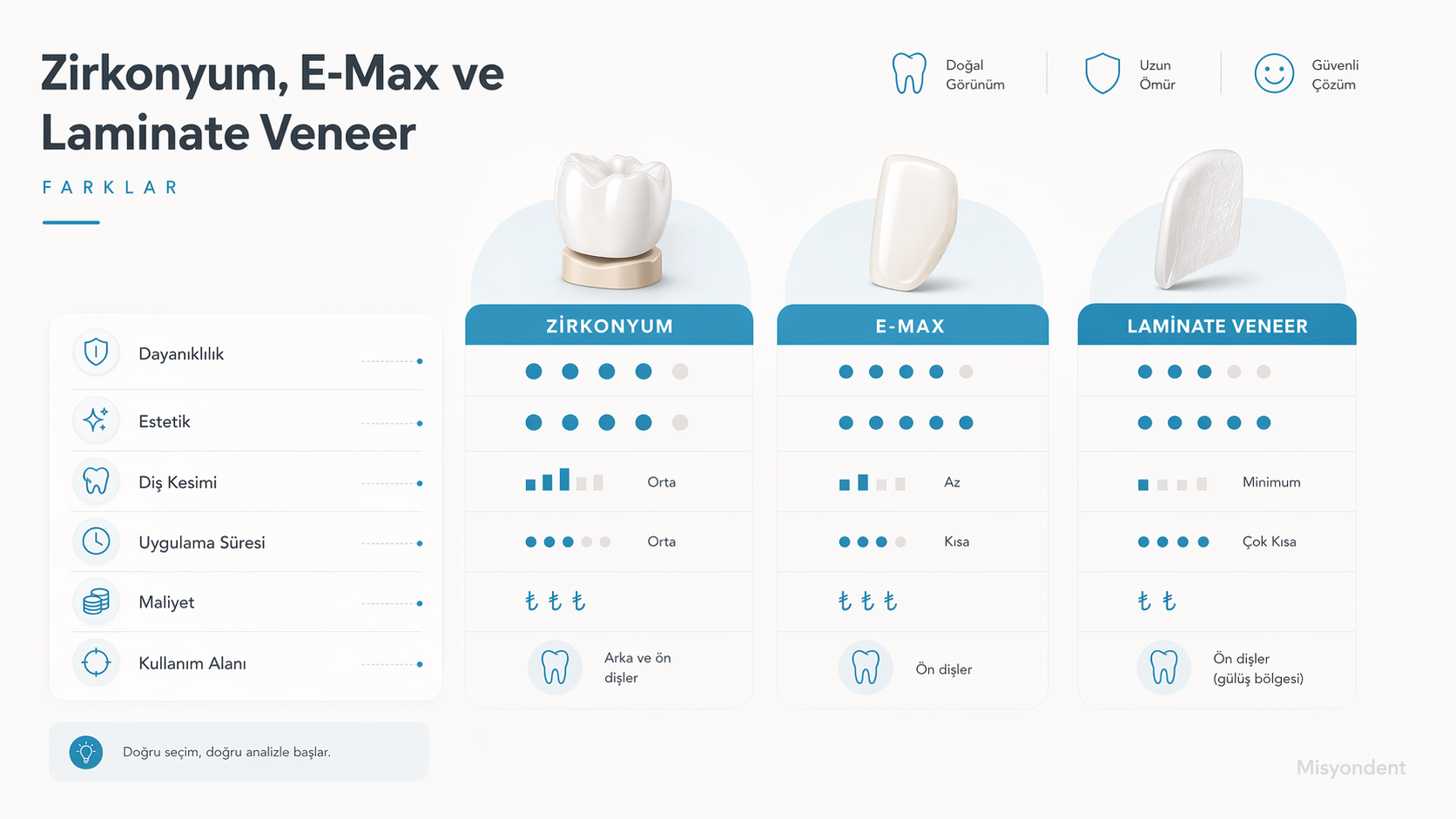
    Differences between Zirconium, E-Max and Laminate Veneer

    Zirconium, E-Max (lithium disilicate glass ceramic) and laminate veneers are not substitutes, but options that respond to different clinical situations. Zirconium is preferred especially for posterior teeth, root canal treated teeth and bridges due to its high durability. While E-Max stands out in aesthetic veneers in the anterior region with its high light transmittance; laminate veneer is a thin porcelain layer applied only on the front surface of the tooth, requiring minimal tooth tissue cutting.

    Only a medical examination can determine which option is right for you. E-Max coatings advantages and laminate veneer application Detailed information about the clinic is provided separately on our clinic pages.

    Teeth Whitening Frequently Asked Questions (FAQ)

    How many sessions does it take to complete a zirconium crown?

    In most cases, zirconium dental crowns are completed in two clinical sessions. The first session includes examination, tooth preparation, impression taking and placement of the temporary crown. The laboratory production time usually takes 3-7 working days. The second session includes a fitting, necessary adjustments and final bonding. In cases requiring preliminary preparation (root canal treatment, gum treatment), the total time may be longer. The exact duration will be informed by your physician according to your treatment plan.

    Will zirconium teeth turn yellow?

    Zirconium dioxide is not absorbent due to its structure; therefore, the veneer itself does not directly turn yellow with factors such as tea, coffee and cigarettes. However, the adhesive at the gum line may change color over time, and the color change in the surrounding natural teeth may contrast with the veneers. Regular professional cleaning, soft brushing and the use of non-abrasive paste are recommended to minimize the color difference. During the six-monthly check-ups, your dentist can refresh the veneer.

    Can I develop an allergy to zirconium veneers?

    Zirconium dioxide is a biocompatible material and metal-free. This makes it a safe option for patients with sensitivity to metal alloys. Reports of allergic reactions to zirconium material are very rare in the clinical literature. However, temporary sensitivity to adhesive agents may occur; if you have a known dental material allergy, be sure to inform your physician before treatment.

    Is tooth brushing different after a zirconium crown?

    The daily brushing routine is the same as for natural teeth. A soft-bristled brush, fluoride toothpaste and brushing twice a day is sufficient. It is especially important to clean the transition line between the veneer and the gums; floss or an interdental brush should be used for this area. It is okay to use an electric brush. Avoiding abrasive whitening pastes helps to maintain the surface shine.

    How can I reach your clinic in Bahçelievler?

    Our clinic is located at Bahçelievler Mahallesi Colonel İbrahim Karaoğlanoğlu Sokak No: 20B in the center of Bahçelievler. By public transportation, we are close to metro, metrobus and bus lines; by private car, it is possible to reach from surrounding districts such as Bakırköy, Güngören, Bağcılar, Küçükçekmece, Bayrampaşa and Zeytinburnu in a short time. When making an appointment, our physicians can give you additional information about parking and transportation options. For detailed directions, please call +90 533 397 65 56.

    Will my insurance cover the zirconium crown?

    Zirconium coating is considered within the scope of aesthetic treatment in most private health insurances; SGK generally does not cover the costs of aesthetic coatings. Since it varies according to the policy coverage of your insurance, we recommend that you contact your own insurance company for precise information. You can call our clinic or fill out the online appointment form for contracted insurance information and billing process. Our team will guide you through the process.

    Can people under 18 have zirconium veneers?

    Zirconium veneers are generally not recommended for individuals under the age of 18. The main reason for this is that the jaw and gums are still developing; veneers made before the development is completed may require incompatibility or reconstruction in the future. In this age group, your doctor may recommend temporary solutions for aesthetic problems that occur after trauma. The best time for permanent restorations is when the jaw-facial development is complete.

    Conscious Preparation Means a Healthy Coating.

    Zirconium dental crowns are a long-lasting solution both aesthetically and functionally when planned correctly in the right patient. The success of the treatment depends on three elements: the health of the underlying tooth and gums, the precise preparation and compliance work of the dentist, and the patient's daily care and six-month check-up habits. When these three elements are aligned in the same direction, safe use of the crown for more than 10 years is possible for many patients.

    If the idea of dental veneers seems distant or scary to you, the best step would be to clarify the situation with an examination, not a diagnosis. By talking to your dentist, you can find out which type of treatment (zirconium, E-Max, laminate veneer or restoration after root canal treatment) is suitable for you and make the process predictable. Early evaluation means less intervention and longer life.

    Misyondent Polyclinic for Zirconium Dental Veneers in Bahcelievler

    Misyondent Oral and Dental Health Polyclinic is a neighborhood clinic serving in the field of aesthetic and restorative dentistry in the center of Bahçelievler. In our zirconium crown processes, we apply modern methods such as digital impression, CAD/CAM compatible laboratory cooperation and personalized color analysis as an integral part of the treatment plan. Specializing in aesthetic dentistry our clinical physician staffThe specialist evaluates the type of veneer (monolithic or layered zirconium) according to each patient's oral structure and expectations.

    Throughout the process we have touched more than 300 patients, what we prioritized was the right result, not the fast result. Sometimes we may recommend root canal treatment, gum treatment or another restoration method to a patient instead of zirconium; because a sustainable aesthetic is only possible on a healthy infrastructure. Strong doctor-patient communication, a treatment plan that clearly shares every step, and an ongoing control approach afterwards define the way our clinic works.

    Thanks to our Bahçelievler-based location, we reach our patients from many districts of the European Side, especially Bakırköy, Güngören, Bağcılar, Küçükçekmece, Bayrampaşa, Esenler and Zeytinburnu. Being close to metro, metrobus and bus lines provides a practical advantage that facilitates appointment continuity. If you want to get an evaluation about zirconium veneers or a different aesthetic dentistry service, as Misyondent, you can call our hotline +90 533 397 65 56 or you can schedule your first examination by filling out the online appointment form.

    Health Factsheet

    This content, Misyondent Oral and Dental Health Clinic specialized dentists in line with current clinical literature and professional experience. It is intended for general information purposes only and does not constitute medical advice. For individual assessment appointment with our specialist physicians is recommended.

    Was this content useful?Your feedback helps us improve our content.

    🙏

    Thanks for your feedback!

    Would you like to get expert support on the subject?

    Share your feedback with us

    What would you like to know more about? Your feedback helps us improve our content.

    Thank you, WhatsApp is opening!

    Your message has been prepared. Confirm on WhatsApp to send.

    Misyondent Oral and Dental Health Clinic - Your feedback is valuable for content quality
    Our location
    Bahcelievler / Istanbul

    Misyondent Dental Clinic

    Bahçelievler Mah. Colonel Ibrahim Karaoglanoglu Sok. No:20B, Bahçelievler / Istanbul


    Nearby Districts Make an Appointment

    Hft-Cum: 09:00-18:00 - Sat-Mon: Closed

    5.0 (44)
    Dt. Deniz Caliskan - Aesthetic Dentist, Misyondent

    Dt. Deniz Caliskan

    Aesthetic Dentist - Misyondent

    Expert author
    10+ Years of experience
    300+ Happy patient
    5.0 Google score

    Born in 1987, Dt. Deniz Çalışkan completed her dental education at Sofia University. Specializing in aesthetic dentistry, Çalışkan offers customized solutions for each patient in zirconium veneers, smile design and minimally invasive treatments.