This content is created by Misyondent Oral and Dental Health Clinic's team of expert dentists. reviewed by the clinical team and validated. It is based on current clinical literature and applied dental practice.
Our patient, Bilge K., came to our clinic hoping to achieve a brighter, more even, and more aesthetically pleasing smile. During the initial evaluation, it became clear that she was hoping for a more harmonious result, particularly in terms of the shape, shade, and smile line of her upper front teeth.
The initial photograph revealed that the upper teeth had areas where improvements could be made in terms of color, shape, and surface texture; it was determined that the natural color of the lower teeth needed to be adjusted to match the planned upper jaw restorations. For this reason, the treatment was planned not merely as a procedure involving veneers on the upper teeth, but as a more detailed aesthetic plan that addresses the color coordination between the upper and lower jaws.
In this case, in the upper jaw 10 E-Max crowns, as a supplement 2 fillings, 1 root canal treatment, 1-channel in-channel whitening, 1 scaling and to enhance color harmony in the lower jaw 1 laser whitening was implemented.
Treatment process 18.02.2026 started on 04.03.2026 was completed on During this period, our patient was admitted to our clinic He came five times.
Applied Treatments
The following procedures were performed as part of the treatment plan developed for Bilge K.:
- 10 E-Max crowns, upper jaw
- 2 fillings
- 1 in-office teeth whitening treatment
- 1 cleaning
- 1 root canal treatment
- 1 laser whitening treatment, lower jaw
The primary goal of this treatment plan was to create a more aesthetic and naturally translucent smile in the upper jaw, while also making the color of the natural teeth in the lower jaw more harmonious with the new upper restorations.
E-Max crowns are restorations often chosen for anterior aesthetics due to their natural appearance, translucency, and elegant surface texture. However, it is important to remember that aesthetic success depends not only on the veneer material but also on gum health, existing fillings, the need for root canal treatment, color matching, and the try-in stages.
Our Patient’s Reason for Seeking Treatment and Aesthetic Expectations
When Bilge K. came to our clinic, she wanted her smile to look brighter, more balanced, and more aesthetically pleasing. Since her upper front teeth were particularly noticeable when she smiled, achieving harmony in color and shape in this area was central to the treatment plan.
Our patient’s goal was not to achieve an overly artificial or excessively white appearance; rather, it was to achieve a smile that harmonizes with their facial features, appears cleaner, and preserves their natural aesthetic lines.
For this reason, during the planning phase, we sought answers not only to the question “How can the upper teeth be made whiter?” but also to the following questions:
- Will the upper jaw restorations match the natural teeth in the lower jaw?
- Are the front teeth the right length for the lip line?
- How does the shape of the teeth affect a patient’s facial expression?
- How can the current tooth color be matched with E-Max restorations?
- Does whitening the lower jaw help achieve color consistency?
- If there is discoloration inside the canal, is external bleaching sufficient on its own?
Thanks to this approach, the treatment was planned not merely as a cosmetic procedure on the upper jaw, but as a more comprehensive process that affects the overall appearance of the smile.
What was evaluated in the Kick-off Photo?
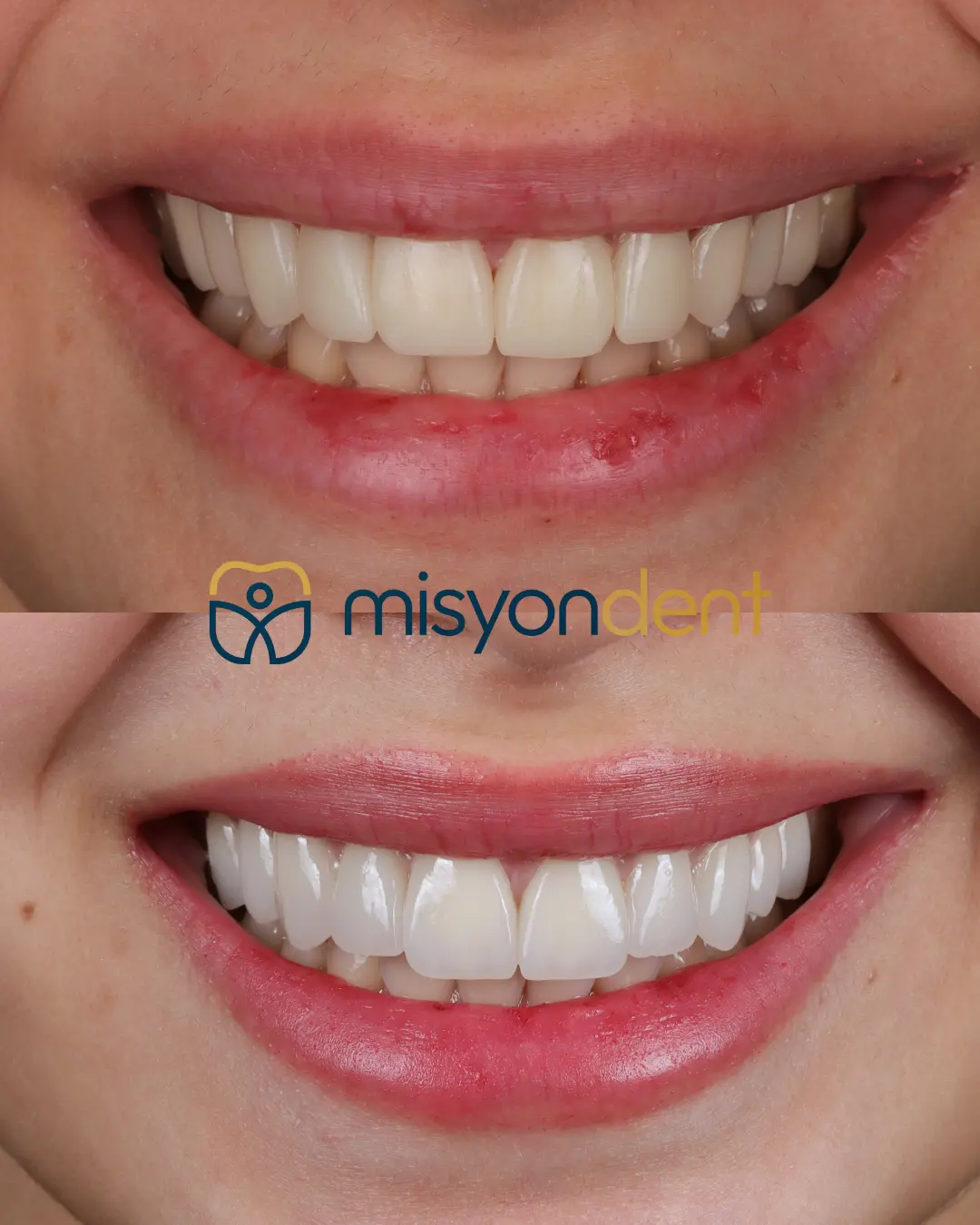
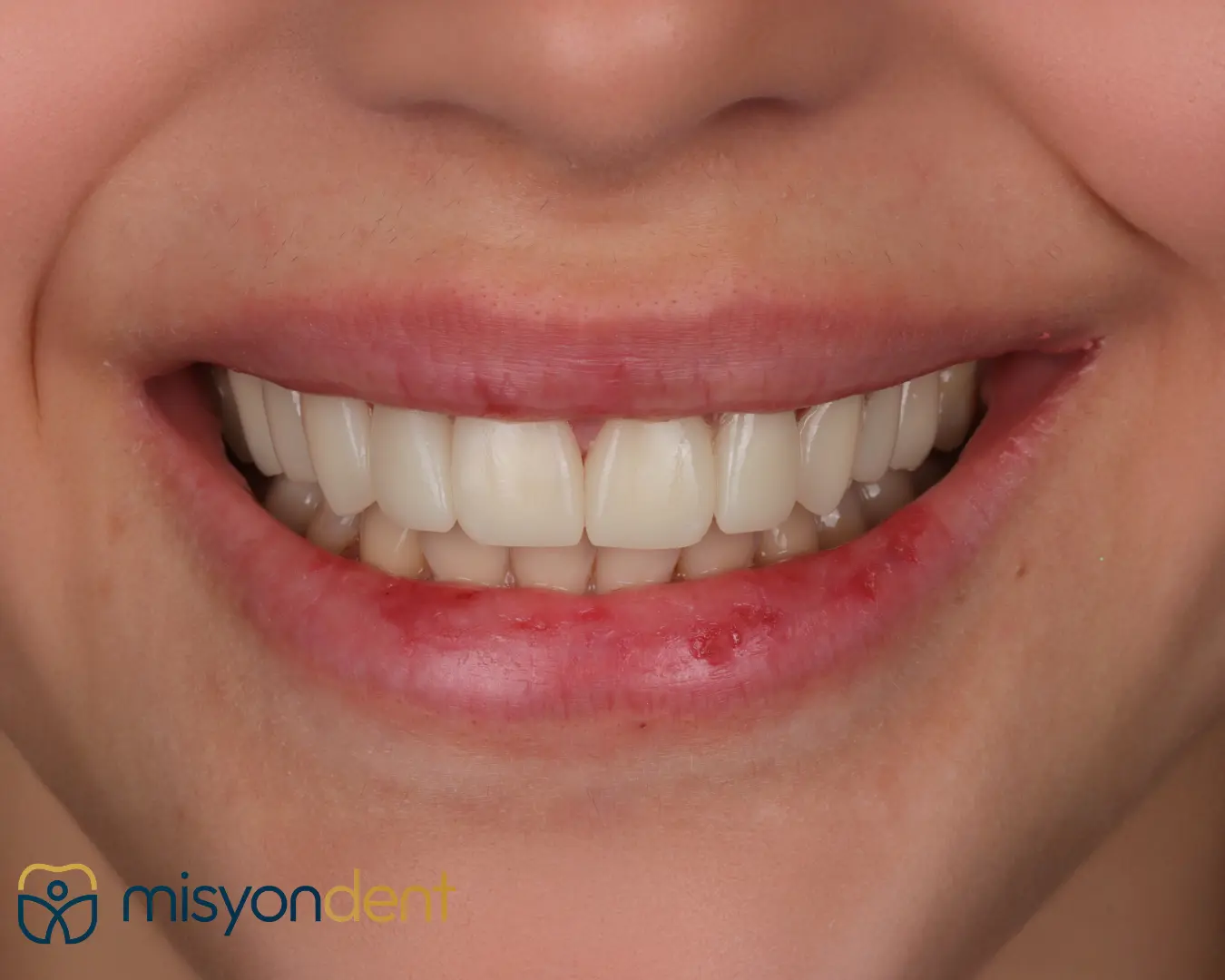
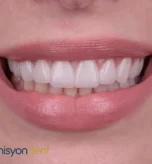
The pre-treatment photograph showed that the upper front teeth were clearly visible when smiling, and that the color, shape, and surface characteristics of this area affected the overall appearance of the smile. It was determined that a more balanced shape, a brighter shade, and a look that better harmonized with the lip line could be achieved for the front teeth.
In cases like these, simply whitening the teeth may not be enough. This is because the shape of the teeth, their surface texture, the proportions between them, and the smile line also directly affect the aesthetic outcome.
The treatment plan for Bilge K. called for a more controlled aesthetic design using E-Max veneers on the upper jaw; for the lower jaw, laser whitening was planned to create a base that better matches the color of the new upper restorations.
How Did the X-Ray Evaluation Guide the Treatment?
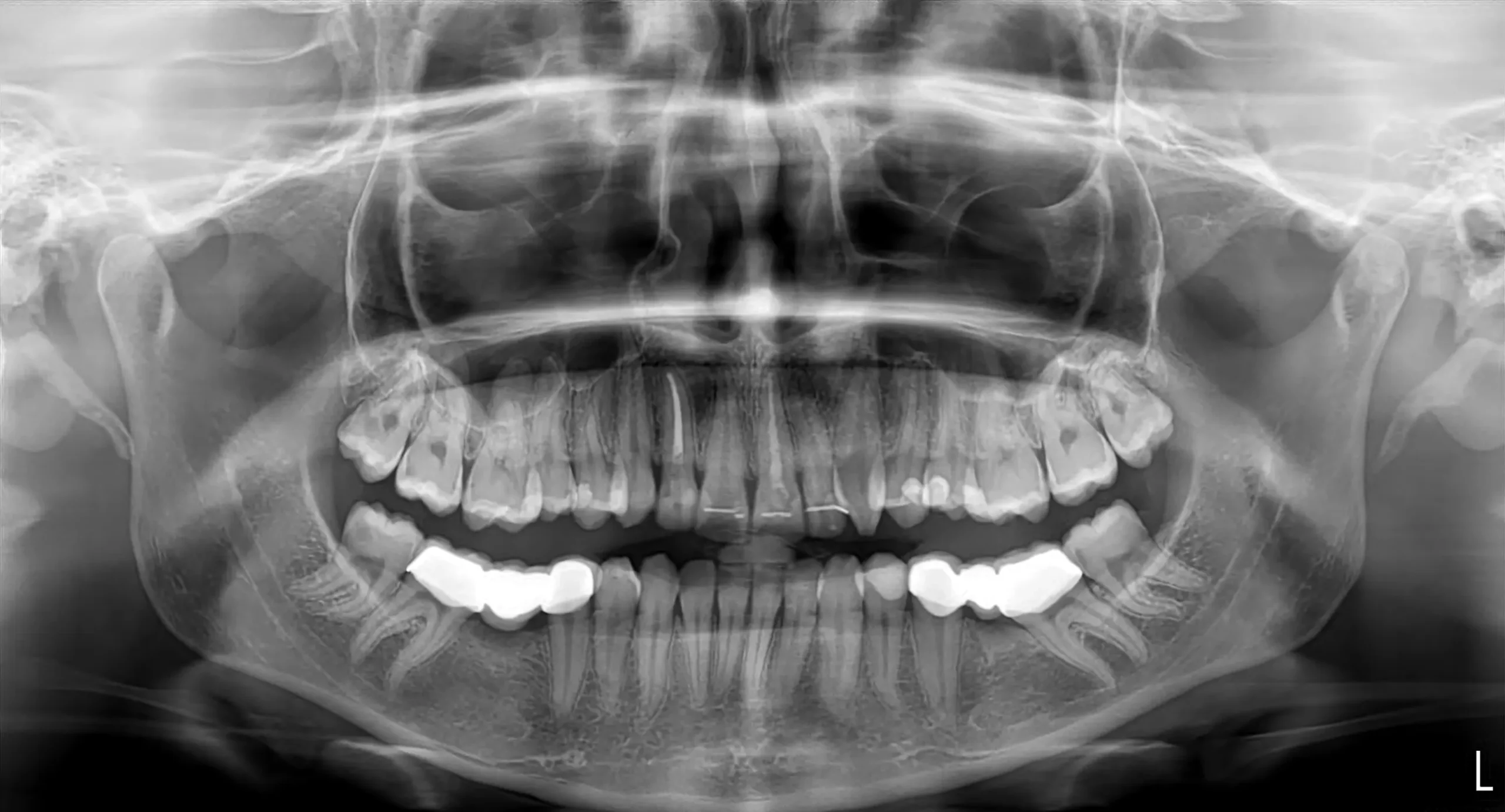
A panoramic X-ray evaluation was performed before starting treatment. This evaluation examined the tooth roots, existing restorations, the need for root canal treatment, the need for fillings, and the overall condition of the mouth.
X-ray evaluation is a crucial step in cosmetic dental treatments. This is because even a tooth that appears healthy on the surface may have an old restoration, require root canal treatment, or have another condition causing discoloration. For this reason, it is essential to assess the underlying structure of the teeth before proceeding with cosmetic restorations such as E-Max crowns.
In the treatment plan developed for Bilge K., in addition to the E-Max procedure for the upper jaw, root canal treatment on one tooth, in-root whitening on another tooth, and restorative treatment for two fillings were included in the treatment plan.
Why Zirconium Veneers on 1 Tooth?
The needs of each tooth may not be the same. While lamina veneers may be sufficient for some teeth, some teeth may require a restoration that provides more support.
In our patient, zirconium crown was preferred for that area by evaluating the existing structure of a tooth, its durability need and its position in the treatment plan.
Zirconium crown is an option that can be preferred in cases where aesthetic appearance, durability and all-round support of tooth tissue are required. In this case, it was planned as a more suitable solution for the relevant tooth without disrupting the integrity of the overall smile design.
Why Were 10 E-Max Crowns Planned for the Upper Jaw?
In our patient’s smile, the upper teeth played a more prominent aesthetic role. For this reason, it was deemed necessary to plan the treatment of the upper front teeth together to achieve a more harmonious result.
10 E-Max crowns The reason for the treatment plan was to ensure that the teeth visible in the upper jaw when smiling were arranged in a harmonious manner in terms of color, shape, and surface texture.
E-Max veneers were chosen for this case for the following reasons:
- Improve the color and shape harmony in the upper front area
- To create a more balanced smile line
- To make teeth appear more naturally translucent
- Adjusting the size and proportions of the front teeth to match the shape of the lips
- To maintain overall color consistency with lower jaw whitening
- Planning to meet the patient's expectations for a more elegant and natural smile
The key point here is that E-Max veneers are not intended merely to achieve “whiter teeth,” but rather to redefine the aesthetic composition of the upper jaw.
Why Was In-Channel Whitening Performed?
During this treatment process, a tooth in-channel whitening was performed. In-root canal bleaching is a procedure that can be considered, particularly for teeth that have previously undergone root canal treatment or exhibit intrinsic discoloration.
In some teeth, discoloration isn’t caused solely by the outer surface. Color changes within the tooth’s internal structure may not be adequately corrected by standard laser whitening or surface whitening procedures. In such cases, in-tubule whitening may be planned to make the color of the affected tooth more harmonious with the surrounding teeth.
For Bilge K., this procedure was considered a preparatory step to achieve a result consistent with the overall color scheme of the E-Max restorations.
Why Was Laser Teeth Whitening Performed on the Lower Jaw?
In this case, E-Max veneers were applied only to the upper jaw. However, since the lower teeth are also visible to some extent when smiling, color matching between the new upper restorations and the natural lower teeth was also taken into account.
The purpose of performing laser whitening on the lower jaw was to lighten the color of the natural lower teeth and create a more balanced appearance with the E-Max veneers on the upper jaw.
This approach is particularly important in cases where aesthetic veneers are applied only to the upper jaw. This is because if the lower teeth remain noticeably darker while the upper teeth are being restored, the color difference may be noticeable when smiling.
For this reason, lower jaw laser whitening was planned for Bilge K. as a complementary procedure to help her final smile look more complete.
Why Was the Detartration Done at the First Appointment?
During the first appointment of the treatment process, scaling—that is, the removal of tartar—was also performed. This procedure is an important preparatory step that supports gum health and ensures the quality of impressions prior to aesthetic restorations.
Tartar and plaque buildup can make it difficult to accurately assess the gum line. However, in aesthetic restorations such as E-Max, harmony with the gums is crucial in terms of the margins of the restoration and a natural appearance.
For this reason, the scaling procedure in Bilge K.’s treatment was not considered separate from the veneer process; rather, it was viewed as one of the initial preparatory steps that facilitates a more successful aesthetic planning process.
How many times has our patient visited the clinic, and what was done at each appointment?
Bilge K.'s total treatment duration 5 clinic visits was completed. Each appointment addressed a different stage of the treatment. This ensured that the E-Max veneer process proceeded in a controlled manner, while supportive procedures such as root canal treatment, fillings, in-tubule bleaching, scaling, and laser whitening were incorporated into the treatment plan in the correct sequence.
1. Appointment: Tooth Preparation, Digital Impression, and Scaling
During the first appointment, the teeth were prepared for the E-Max crowns on the upper jaw. At this stage, the teeth were prepared to ensure the planned restorations would fit properly, and a digital impression was then taken.
Digital impressions enable the three-dimensional capture of teeth using intraoral scanners. These scans help ensure that E-Max crowns are designed with greater precision in the laboratory.
A scaling procedure was also performed during the same appointment. This allowed for a clearer assessment of the gum line, improved oral hygiene, and provided a healthier foundation for the crown placement process.
2. Appointment: Plastic/PMMA Try-in and Root Canal Treatment
During the second appointment, a PMMA try-in was performed. A PMMA try-in involves evaluating the plastic draft model of the teeth on which the final E-Max restorations will be prepared, directly in the patient’s mouth.
At this stage, the patient’s new tooth dimensions, smile line, relationship with the lips, and overall aesthetic appearance are assessed. Using a PMMA try-in, questions such as “Are the teeth too long, too short, too wide, or do they harmonize with the face?” are evaluated on the patient before proceeding to the final restorations.
The root canal treatment required was also performed during the same appointment. This procedure was important for preparing the tooth to be restored on a healthy foundation. Thus, the necessary treatment for the tooth’s internal structure was completed before proceeding to the aesthetic phase.
3. Appointment: Dentin Try-in and Fillings
During the third appointment, a dentin try-in was performed. At this stage, instead of a plastic model, the actual E-Max restorations were tried in the mouth prior to polishing and final finishing.
A dentin try-in is one of the most critical steps in the treatment process. This is because, at this stage, the color, shape, relationship to the gums, harmony with the lips, and overall aesthetic appearance of the restorations are evaluated prior to the final procedure.
During this appointment, two fillings were also completed. The fillings were placed to address minor restorative needs in the mouth and to ensure that the final aesthetic plan was based on a healthier oral structure.
During the dentin test, the following details in particular were checked:
- Does the color of E-Max veneers match the patient's expectations?
- Do the shapes of the upper teeth align with the lip line?
- Does the surface texture of the teeth look natural?
- Do the gum margins align properly?
- Any discomfort in closing?
- Is additional whitening needed to match the color of the lower jaw?
Following these checks, the project moved into the final phase.
4th Appointment: Finishing and Permanent Bonding
During the fourth appointment, the final stage of the E-Max veneers was completed. At this stage, all aspects were re-evaluated: color, shape, occlusion, gum line fit, lip line, and the final appearance as seen by the patient in the mirror.
Once everything has gone according to plan and the patient has approved the result, the E-Max crowns are permanently cemented in place.
After the final checks were completed for Bilge K., the 10 E-Max crowns on the upper jaw were permanently placed. The goal at this stage was to achieve a smile that the patient felt comfortable with and that harmonized with her facial expressions.
5. Appointment: Lower Jaw Laser Teeth Whitening
During the fifth appointment, laser whitening was performed on the lower teeth. This procedure was planned to ensure color matching between the E-Max veneers on the upper teeth and the natural teeth on the lower jaw.
In cases where cosmetic veneers are applied only to the upper teeth, the color of the lower teeth can directly affect the final appearance. If the lower teeth remain too dark, a noticeable contrast may develop between the upper veneers and the lower teeth.
As a result, the laser whitening performed during the last appointment helped create a more balanced overall smile color.
What Was the Most Distinctive Aspect of This Treatment Process?
The most significant aspect of this treatment was that the E-Max veneers on the upper jaw were not considered in isolation. The natural tooth color of the lower jaw, the potential for intrinsic discoloration, existing filling needs, and gum health were also factored into the treatment plan.
In other words, the approach of simply “let’s put veneers on the upper teeth” was not taken during this process. Instead, the treatment plan was developed based on the following questions:
- Will E-Max veneers on the upper jaw look natural?
- Will the color match the natural teeth in the lower jaw?
- Does discoloration inside the canal affect the aesthetic result?
- Should fillers be completed before the final look is achieved?
- Does gum health affect the measurement and fitting process?
- Will the patient be able to properly evaluate the final restorations before they are permanently cemented?
Thanks to this comprehensive approach, the treatment was completed as a process focused not only on aesthetics but also on restoration, function, and color matching.
What kind of change was achieved as a result of the treatment?
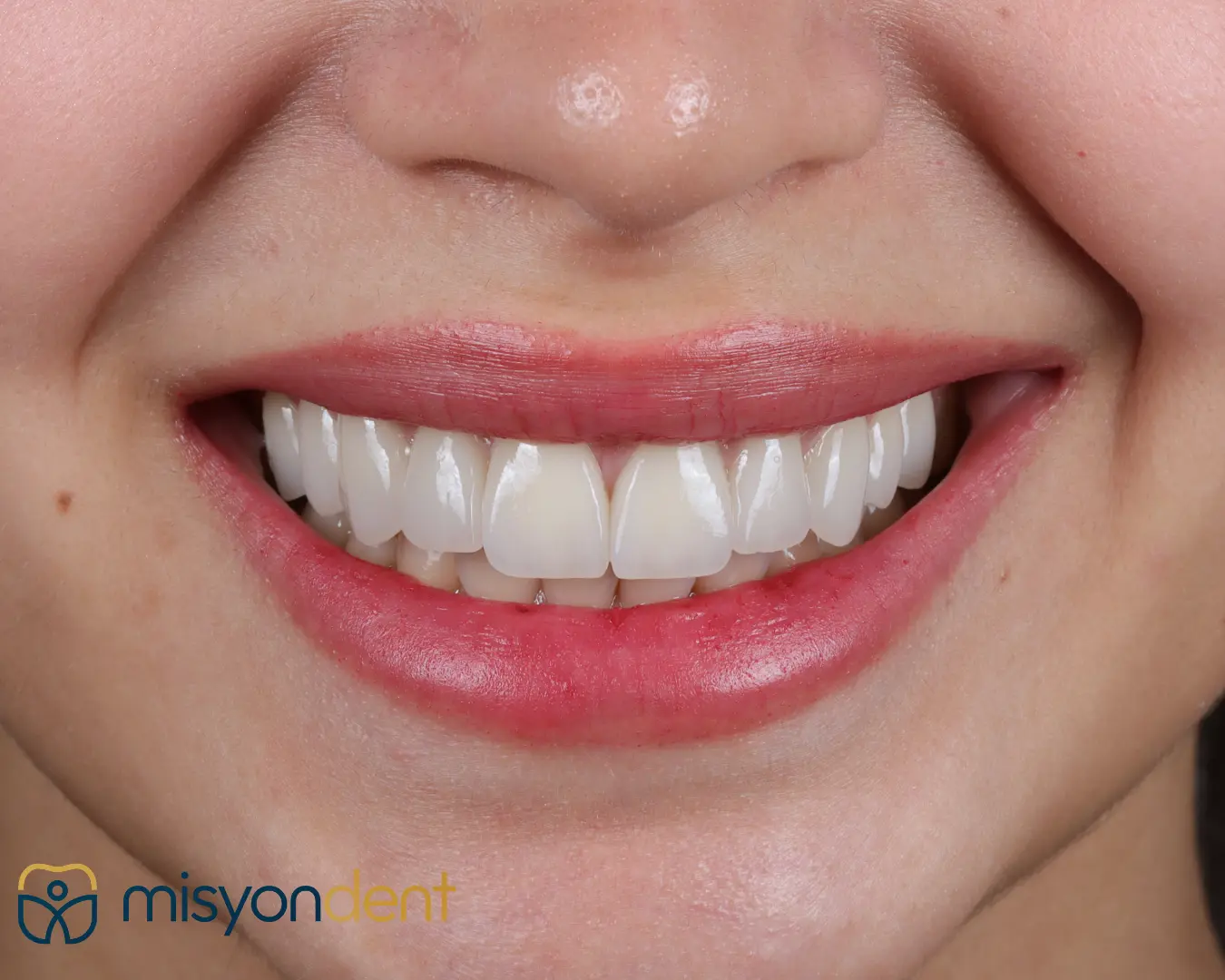
Upon completion of the treatment, our patient achieved a brighter, more even, and more aesthetically pleasing appearance along the upper gum line. The shape and color harmony of the upper teeth were improved with E-Max veneers; laser whitening applied to the lower jaw ensured a more balanced overall smile color.
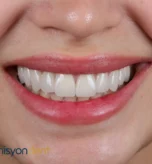
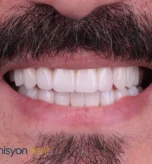
In the final photo, it is evident that the upper front teeth appear more in harmony with the lip line, the teeth have a brighter shade, and the smile has a more refined appearance overall.
The goal of this process was not merely to replace the upper teeth; it was to create a smile that harmonizes with our patient’s facial features, takes into account the color balance between the upper and lower teeth, and appears natural.
For Which Patients Might This Case Serve as a Guide?
This treatment process can serve as a guide for patients who are particularly dissatisfied with their upper front teeth but also want their lower teeth to look harmonious with their new smile.
A similar plan may be considered in the following situations:
- If there are irregularities in the shape and color of the upper front teethIf you only want to have the upper jaw cosmetically restored
- If the color of the lower natural teeth does not match that of the upper restorations
- If there is intrinsic discoloration in a tooth that has undergone root canal treatment
- If gum and oral hygiene need to be addressed before E-Max veneers
- If fillers affect the final aesthetic plan
- If the patient prefers a restoration with more natural light transmission
However, every treatment is tailored to the individual. The need for E-Max crowns, laser whitening, in-office whitening, or fillings is not planned the same way for every patient.
Frequently Asked Questions
Can an E-Max crown be placed on just the upper jaw?
What is the difference between E-Max crowns and zirconia crowns?
Why is laser whitening performed on the lower teeth while E-Max is used on the upper teeth?
Is in-office teeth whitening the same as laser teeth whitening?
Which teeth require in-office whitening?
Why is scaling performed before E-Max veneers?
What is the purpose of PMMA in E-Max treatment?
Why is a dentin test important?
How do I choose an E-Max veneer color?
Do fillings affect the cosmetic restoration process?
How many appointments does it take to complete an E-Max veneer?
Are the coverings applied immediately at the final stage?
Will this result be the same for everyone?
Will my lower teeth look yellower after I get veneers on my upper teeth?
Short Case Summary
- Patient: Bilge K.
- Start date 18.02.2026
- End date: 04.03.2026
- Total clinic visits: 5
- Reason for application: The desire for a more aesthetic, brighter smile on the upper jaw that harmonizes with the lower jaw
- Evaluation: Intraoral photo analysis, panoramic X-ray examination, color-and-form assessment, and upper-lower jaw alignment planning
- Applied treatments: 10 E-Max crowns, 2 fillings, 1 in-office teeth whitening, 1 scaling, 1 root canal treatment, lower jaw laser teeth whitening
- 1st date: Tooth preparation, digital impressions, and scaling
- 2nd date: PMMA impressions and root canal treatment
- 3rd date: Dentin tests and fillings
- 4th date: Finishing and permanent bonding5th appointment: Lower Jaw Laser Whitening
- Treatment approach: Aesthetic form and color were restored in the upper jaw using E-Max veneers; overall smile color harmony was enhanced in the lower jaw through laser whitening.
- Conclusion: The result is a brighter, more balanced, and more elegant smile that complements the facial features.
This treatment process is planned specifically for the oral and dental structure of our patient. Each patient's treatment needs, the number of procedures to be performed, the number of appointments and the result to be obtained may be different. In order to determine the most suitable treatment options for you, a detailed examination and physician evaluation is required.
Images have been shared for informational purposes with the express consent of our patient. Treatment results may vary from person to person. All treatments are planned individually.
This content, Misyondent Oral and Dental Health Clinic specialized dentists in line with current clinical literature and professional experience. It is intended for general information purposes only and does not constitute medical advice. For individual assessment appointment with our specialist physicians is recommended.
Was this content useful?Your feedback helps us improve our content.
Thanks for your feedback!
Would you like to get expert support on the subject?
Share your feedback with us
What would you like to know more about? Your feedback helps us improve our content.
Thank you, WhatsApp is opening!
Your message has been prepared. Confirm on WhatsApp to send.

Misyondent Dental Clinic
Bahçelievler Mah. Colonel Ibrahim Karaoglanoglu Sok. No:20B, Bahçelievler / Istanbul
Nearby Districts Make an Appointment
Hft-Cum: 09:00-18:00 - Sat-Mon: Closed
5.0
Dt. Deniz Caliskan
Aesthetic Dentist - Misyondent
Expert authorBorn in 1987, Dt. Deniz Çalışkan completed her dental education at Sofia University. Specializing in aesthetic dentistry, Çalışkan offers customized solutions for each patient in zirconium veneers, smile design and minimally invasive treatments.